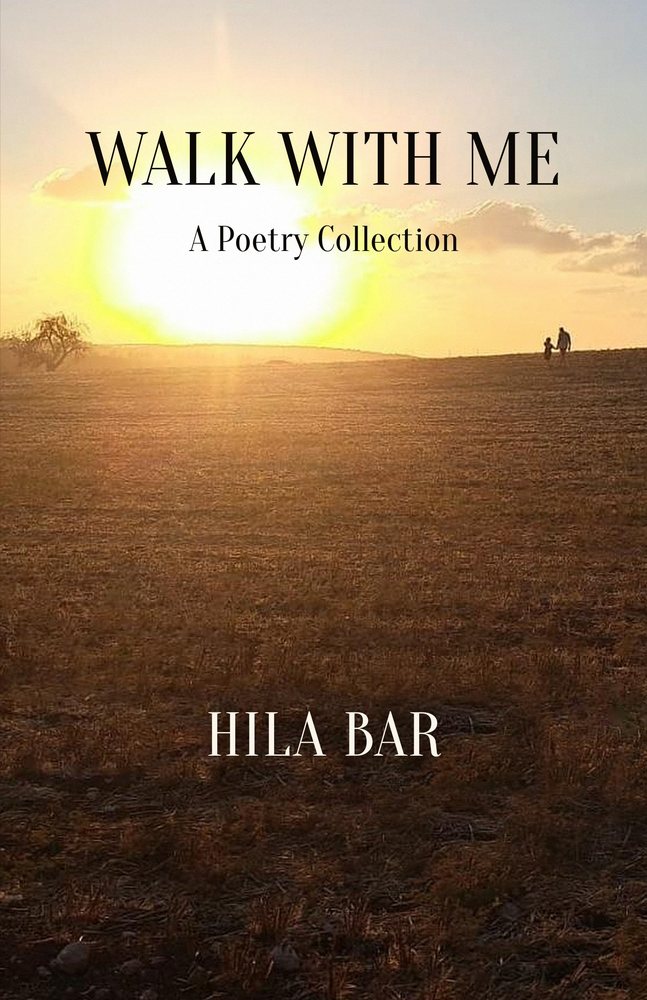
Cover of Walk With Me, a poetry collection by Hila Bar
Poetry

Walk With Me

A Poetry Collection

A collection of poems by Hila Bar.

Published by Painted Wolf Publishing.

Purchase my book on Amazon ↗

Selected Poems

The Cape

I had forgotten the view from Sir Lowry’s PassWhere the cliffs fall down to the bayWhere the Strand opens wide to welcome the seaAnd where apple trees bobIn row upon row upon rowOver waves of fieldsThat stretch across hills and mountain topsBetween places with names likeBoontjieskraal,Dassiefontein,And Jan Harmsgat (What kundofa nayme is thet?)

I had forgotten the sight of baboonsScuttling between fynbos (pincushions)That grows on the side of the road;Perched on a sign pointing to Bonnievale;And a shabby tin boxWhose sign readsANTIQUES (in capital letters)In red paintOn its roof

Have I ever known pasturesWith damsWhere cows and sheep drink and grazeFrom the goodness of the landThat rolls far and foreverLike the river with no endThat I still seek to find in Riviersonderend

I had knownBut forgottenThe soaring greens that charge ahead to the horizonForever invincible,Looming rocks of grey and red(“So nice to see water rushing down the mountainside when it rains”)And roads that dip and riseLike an elongated roller coaster trackAs it ambles along the contours of the hills

And when you turn at SwellendamYou gasp and sayOh, but this land is vast and richHow the sky dances wildly between the passesAnd the clouds bounce up cliffs and down valesUntil you see the land begin to restFinallyAs trees settle in a blanket of shrubsAnd the hills fold up into kopjes

How the land consumes you like a bite of cold airThat fills you till you’re bursting;That lugs the heart weighed downBy a thousand stones at my gravesites of regretTo a place so profoundIt tortures the soul till it begs to be freeBecause, oh, the land is magnificent.

Sad Sunset

SometimesI push myselfIgnoring distance, time, moneyForcing one step in front of the otherGrab my keysTake my bagClose the doorWalk to the carBrush off the grating on my heartAnd drive without thinkingThe hour to the shoreWhere I park and walk the distance to the seaAnd waitAs people pack to go home,And dogs dash in ecstasy,Wondering if I won’t take a photo this timeOr jot some words,As clouds get singed and the sky smouldersWishing for the stragglers to goSo to be aloneBut without the gratingWhile I sink into the sandAnd the sun melts into the sea

Walking Alone

Walking aloneAcross the still sands of a cool morningDay breaks into the salty airWhile fledgling waves prepare for the grand performanceLaterWhen the day’s vibrance crumbles to powderAnd its hues fold into the end of the earthGrabbing hold of our heartsTeasing us with streaks of celestial radianceWe long to master

And then aloneAt water’s edgeFace to face with the sinking sunUntil darkness closes inIts curtain drawing on the bedroom of the worldAnd a deafening climax seizes the momentAs the roar crescendos, then pitifully whimpers awayDisrupting the quietA thousand times over

Or single steps along a forest pathPorcupine needlesPine needlesTree after treeSpirits scampering to hide among the shadowsWatching meJust me alone

You never walk alone, she said.*

I stand between the hills, lush with winter shades of greenA burst of fresh childlike colours of springOr the tired burnt summer earth birthing brittle browned plantsAn exhausted autumn terrainAll as beautiful in its own seasonLike me

Like you

A lone desert driveHas me stopping and scanning the landPale mustard yellow,And the clear, vast spread of skyWhile in between the Divine beckonsEndeavours to penetrate my soulDraws me closer to its shroud of protection

And I sit upon the forest floor, the silky shore, the lush grasses, the desert stone, and dream, for now, of sinking deep and disappearing; being one with beauty, comfort and calm, nourishment and wholeness. With the earth; with the sublime.And when I awake, no more shall I walk alone.

*I had a client who had a near-death experience. This sentence appears in a book she wrote, and for a long time I understood it to mean that whatever you do, no matter how slight, it always has its inevitable impact on others. However, I have since discerned that it can also be understood to mean that no matter how alone you feel, you are always being watched and protected from above.

What did they do before buildings shot up?

What did they do before buildings shot upAnd meshes of concrete ruledAnd the only bright colours were flowers on hillsThat embellished and adorned and bejewelledThe landscapeThat lit up when lightning was the only flashAnd the beat was the rain on the roofAccompanied by the creaky bowsOf cicadas across the bushAnd what would they eat when they had only fruitOr vegetables growing in the fieldThat had never laid sight of a microscope slideOr a test tube sterilised and sealedAnd how did they, without pressing a button,On the cold cold earth keep warmWhat blanket or fire that crackled and dancedWould keep off the chill from the stormWere evenings filled up with nothingBut mute words from books they readAnd the hiss of steam as water boiledAnd the blood that pulsed in their headAs the quiet crept steadily through the cranniesWhile darkness fell sublimeWashing away their flood of thoughtsCould it be I’m at the wrong end of time?

A Knock So Soft

A knock so softUpon my doorSmell the scent of dreadA little louderIgnoreJust carry onAs you did beforeLouder then, it penetrates my ears“I’m not home! Go away!”But the urgeTo knockRemainsLouder still, I coil in fearSo ceaselessly it drumsUpon my headFace in palmsContorted eyesAs tears pry throughUntilI can stand itNo longerMy legsSlowHeavyHelplessPlod alongTowardsThe doorI openIt entersIts black dog traipsing happily behind

Let me show you how to peel a carrot

Let me show you how to peel a carrot.Chop off each end with a sharp knifeThen – and I don’t know why everyone peels the carrot in the air –Uncomfortable, inefficient, not to mention quite clumsy –An orange stick hovering…Never would have thought to do it that way –Rest it on the chopping boardJust like soAnd turn it in your handAs you slowly peel from top to bottom with the other.Round and round you twist itWhile you sweep downwardsOver and overYou can work quicker until you twist as fast as lightningOne, two, three, doneAnd from the other end, where perhaps half a centimetre of peel remains.Twist, peel, twist, peel, one-two-three done.A peeled carrot, smooth and perfect.And now, since I am your mother,We can be mother and daughter,Would you like to try?

Rain in October

16 October 2023 – On the unseasonal rains we had during the first week of the war

Talk to me about rain in OctoberSpeak of the clouds swinging byAnd the rains that tumble to the charred, broken earthAs they topple their cradles from up high

When last did you see it rain in October?With showers that blast to the groundAs they muffle the cries of heartache and griefWhile the dead lie with ne’er a sound

So tell me of drops that seep into the soilAnd wash away summer dustHow is the weather so cool and composedWhile the country sits numb and crushed

Let the water cleanse our hearts and our soulsAs we struggle to see through the hazeBut have you ever seen it rain in OctoberAs it has these past few days?

I Can See With My Eyes Closed

I can see with my eyes closedLines and coloursSwirls of wild winds chasing their tails in infinite spiralsSolid rainbowsThat slowly twirl and disappearBlazing fires of ecstasyConsuming endlessly and never tiringWatery heartsExploding starsGalaxies with soaring cometsEmanating pure white light across the skiesThat reaches out and entersCracks and crevices in broken heartsAnd peopleAnd those who are simply open to receiveAnd those who are kissingOr praying

I can see with my eyes closedDeep down in the darkAnd bottomless:The deeper you go, the further it is

I can see with my eyes closedThe sounds of cars outsideThe door that owns the faraway slamAnd the slamVoices softened by distanceAnd finally the creatures of the nightIn my closet,Behind the fridge,And as they sit dangling their spindly legs over the corner of the roofAnd my own legsStretched beneath my body in my mindAnd my body is at rest, my mind at peace.

I can see with my eyes closedA shimmer of violet lightExtending upwards to the heavensFirst scant sparkles, soft waves, and then a mighty blastColliding with the white that descends from above.

And the sounds ceaseAnd my breathing is evenAnd my body is at rest, and my mind at peaceAs I gently settle in a place between violet and whiteHovering at the encounterBetween heaven and earthSo that whatever I see with my eyes closedI shall see with my eyes open too.

When God Paints the World

When God paints the world, He paints it so brightDashes of colour blinding my sightWhat is this angelic lightA pure and dazzling frenzy

A sea too intenseTo embrace its depthsAs Your fiery orange singes my beingBright cerise screamsAnd presses my faceInto a corner of pain

When You paint the worldBe gentleBecause You might knock over the jar of black. Again.

Essays

Selected Essays

Supermarket Scenes – Erev Rosh Hashana

“I’m behind you.” The woman tapped me on my shoulder and walked off. “I’m sorry,” I called out. “I don’t keep places in the queue.”

The till stood opposite the exit, where the expanse beyond opened up to shoppers leaving with trolleys laden with bags, smaller shops in the distance, and the general movement of passersby. I was next in line, and my mind wandered from that woman to my phone messages, to hoping I hadn’t left anything off my shopping list, only to be jolted to the present by the sound of the security guard trying to help the older man in front of me stabilise his trolley so that it wouldn’t roll away. Without success.

“Here, I’ll hold it,” I said.

I watched intently as he packed only one, two, or three items into a bag, and painstakingly tied the bag closed. Once he had three or so bags, he placed them all into a fourth bag, slowly coaxing and enveloping them in. He then tied another knot and carefully lowered it into his trolley, giving it a pat, a smooth-over, manoeuvring it here and there to afford it its perfect place. Considering his full load of shopping, this was taking a while, and the cashier delayed ringing up my soon-to-be purchases and waited patiently.

Delays in shopping queues are a good opportunity to stand around and do nothing, a good time to exercise patience. So I joined the cashier in waiting, still steadying his trolley and watching, almost mesmerised. She began ringing up my items as the man packed his final bag and then left the supermarket.

Just then, she gasped.

“What is it?” I asked.

She pointed to some items shoved to the edge.

“He forgot these. Moshe, Moshe!” she called.

“Levi!” yelled the security guard.

The back of Moshe Levi could be seen gradually receding into the crowd. I jumped towards the exit and yelled, “Moshe! Moshe!” He stopped, turned around, and the guard brought him his forgotten purchases.

Meanwhile, my mushrooms had fallen from the till surface to the floor. With my trolley between me and the mushrooms, it was going to be difficult to pick them up myself.

“Excuse me, excuse me,” I called to the man behind me. “Could you please pick up my mushrooms?”

Oh, no. One of my reusable shopping bags had also fallen.

“Do you think you could also pick up that Rami Levy bag?”

He cast me a shocked look.

“That’s my bag,” he said.

“Oops, I’m sorry. Thought it was mine.”

“Look,” he said, displaying its contents, as though to prove his point.

So Moshe now had all his shopping, I had my mushrooms, and eventually my shopping was paid for. As I passed a specialty food shop on the way out, I realised I must have some of their beautiful-looking pomegranates that were on display. So I walked to my car, pausing to linger over a child’s dropped card collection scattered on the ground along the way, loaded it with my purchases, and went back for my pomegranates. The cashier at the specialty shop was handing out free honey cake once the customers had bought their goods, and as she gestured to the man in front of me, something told me that the stirring inside me at that instant was a shift resulting from her act of giving, together with my time and patience for Moshe.

I left the store with thoughts of pomegranates, honey cake, and bags being ever-so-meticulously tied. On my way to the car, I noticed that the dropped cards had been reclaimed – or swept away.

The House in Mossel Bay

The floor beneath my bed is made of 110-year-old teak, that creaks and bears witness to its hollow silence each time I gingerly place my foot on its surface. Old and knowing, deep chestnut shine, what noises has your stillness swallowed? Who have you called to silence, besides me, so that it proclaims a voice of its own?

The ancient latches had escaped my memory, along with the old-fashioned light switches, that sweep me back through a tunnel of time, fill me with the fumes of nostalgia, choke out the memories of an innocent age, a world painted with purity. Void of TV and internet, deep quiet, as though strung by the strings of a silent instrument, permeates the passage with its high ceiling and line of looming doors.

And all that seeps through the cool night air is the whoosh of the waves, as they roll and clamour for the rocks on the shore, burgeoning into towers of froth and foam until they climax with a roar and then retreat with a whimper.

But for the crash of the ocean, as real and majestic and vast as you can imagine, I adore your steady stillness, that draws me down into the covers, coaxes my arm to reach out for a book, hardcover, swelling the silence with mute words from a page. I adore your luring silence that kneads and presses me into the corner of my melancholia, and I adore the quiet that echoes through the creaky house, and the waves flung across eternity to touch rocks and lives.

I think I’ll watch a movie tonight

I think I’ll watch a movie tonight (or two), because… what else am I meant to do?

Shall I read or write into the deep, silent night? Or finally give in to cleaning the house so that the air smells of lemon or lavender or pine or whatever, and the spirit feels cleansed? And then I can take a walk in the dark among the trees because we can never scour our souls enough.

Even when the wind threatens to rip into your clothes and slash your skin with its icy blow, and you make out the distant call of the jackal to his mate across the vastness; when the lightning flutter of a bat brushes past; and the clouds slowly amble across the surface of the moon (which always evokes an African night, and I wonder how the mantis felt as he watched the shining moon, obscured in ever-changing slivers and wedges by bushveld clouds gliding across the sky).

But the air is still quiet, and I may do better than contend with the peaceful force of the night that threatens to sever the swirling chaos of my mind and arouse the pull towards balance or the primal allure of the universe, its solitude, and mysteries like the moon concealed.

The heavens have opened anyway, but no path is revealed; no mystical portal of stars that illuminate the way. So why shower me with your sorrow? It does nothing but render me wet and wasted – of time and emotion; of dreams and hopes; from the never-ending gnaw of what might have been; of the thought that nothing is for nought – but when does nought become a number?

So I think I’ll stay in where it is warm and draw the lifeless air into my lungs, and then shall I tune in to – or hook up with – the wonders of technology.

Are we not partial to the sounds of fast music and pounding beats; the noise of skidding cars and gunshots? It fills the void at least.

Pride & Prejudice – Impressions

~The work is rather too light, and bright, and sparkling; it wants shade; it wants … a long chapter of sense … [or] something unconnected with the story … anything that would form a contrast and bring the reader with increased delight to the playfulness and epigrammatism of the general style.~ Jane Austen

“Elizabeth is a lady.”

The words ring through my head. A lady. She dashes through the fields and arrives muddy and unkempt, yet she remains a lady.

When the bell rings for class, you can hear the students’ groans. Not mine, though. Mrs Cohen is a good teacher, I think, but you could fall asleep to her voice. Her monotone buzzes through the classroom like those oblong fluorescent lights switched on. It’s my first year studying with her, and we have started off with a book that has captivated me – because of Eliza the lady – and in the years to come it evolves into more than a classic as it accompanies me through life and takes to the cinema and TV screens.

One day the class is presented with “Light and Bright and Sparkling” – the title, she announces, of our first essay assignment. I have no idea what to do; I hardly understand what it means, and if I don’t know what it means, how are some of the other students going to fare in this essay? A day or two of brooding over the assignment go by and then a sudden flash lights up my mind. The library! For some, an obvious solution, to others – genius. Might our school library, crammed with a wealth of magnificent books, hold the key to this bright and sparkling mystery?

The library building stands alone between the middle school situated higher on the hill, and the high school lower down. When I was in middle school, I would regularly see Mrs McKinley, the school librarian, and her daughter at music eisteddfods, until one day – “Alice will be taking up the oboe. Since it’s not a very popular instrument, there won’t be as much competition to be accepted by the orchestra.” So that was the last I saw of Alice. By the time I reach high school, Mrs McKinley has left the school and now Gerard has taken her place. He has a cat and has hung up a collage of cat photos on the library wall to the left of the doorway, as you enter – a large assemblage of intense oranges interspersed with black.

I have no idea how I land myself in this particular aisle; I must have searched through the catalogue cards. Melville Dewey. But I find myself standing opposite tall shelves packed full with books, hoping for some redeeming sign to appear. And then it catches my eye. A book of essays; something about Jane Austen. I draw it out and skim the contents. And there, on that elaborate list, I can’t believe what I’m seeing. An essay called “Light and Bright and Sparkling,” the same as our assignment. Is Mrs Cohen trying to compare the class with an academic elite? Will she be sitting with this book opened in front of her, laughing as she compares our feeble attempts with his? If I were the only person in the history of the school to have taken out this book, I would not be surprised.

At home, I organise my desk and begin to write. I lift all the ideas out of the essay and place them shakily in the body of my assignment, making sure to add my individual touches.

Mrs Cohen gives me a good grade. I think she is pleased.

And then comes the turning point, the class when Elizabeth is a lady. I am sleepy from Mrs Cohen’s voice, yet her description of Eliza Bennet strikes my sacral centre:

“The other women may be upper-class and affluent, and hold titles like Lady, yet they are pretentious and gossip. But Elizabeth is a true lady. She is authentic and doesn’t hesitate to go running through the mud when she hears her sister is ill. Her authenticity gives her dignity. Elizabeth is a lady.”

So begins an ongoing, lifelong battle between running through the mud and retaining dignity; between letting the child surface, yet keeping a refined air; floating in limbo between playful and proper, rough and refined. I seem destined to tread around a fine seam sewn intricately between two folds, with either a brush on the one side or a sweep against the other, and occasionally overstaying my welcome on either fold.

I am still learning to accept that in my attempt to highlight the delight that lies between light, bright, and sparkling and a long chapter of sense, I will never quite manage to tread on the seam, since the thread that binds it is clearly too delicate to touch.

“She did, indeed, Louisa. I could hardly keep my countenance. Very nonsensical to come at all! Why must she be scampering about the country, because her sister had a cold? Her hair, so untidy, so blowsy!”

“Yes, and her petticoat; I hope you saw her petticoat, six inches deep in mud, I am absolutely certain; and the gown which had been let down to hide it not doing its office.”

“Your picture may be very exact, Louisa,” said Bingley; “but this was all lost upon me. I thought Miss Elizabeth Bennet looked remarkably well when she came into the room this morning. Her dirty petticoat quite escaped my notice.”

“You observed it, Mr. Darcy, I am sure,” said Miss Bingley; “and I am inclined to think that you would not wish to see your sister make such an exhibition.”

“Certainly not.”

“To walk three miles, or four miles, or five miles, or whatever it is, above her ankles in dirt, and alone, quite alone! What could she mean by it? It seems to me to show an abominable sort of conceited independence, a most country-town indifference to decorum.”

“It shows an affection for her sister that is very pleasing,” said Bingley.

“I am afraid, Mr. Darcy,” observed Miss Bingley in a half whisper, “that this adventure has rather affected your admiration of her fine eyes.”

“Not at all,” he replied; “they were brightened by the exercise.”
Meeting at Martin Place

For a period during the years we lived in Sydney, I would park my car most mornings in Bondi near the train station. From there I’d walk to catch the train to the city centre, where I’d disembark at Martin Place.

Almost every morning I’d stop on my way to work to buy myself a freshly squeezed juice. I don’t remember exactly which combination of fruits and vegetables, but it would include beetroot, apple, and ginger. Definitely ginger. If not a juice, I’d buy a fruit salad for later, making sure that it contained pineapple. The supply of fruit and vegetables was huge, given the proximity to Asia and the Queensland sub-tropical climate, enabling the cultivation of a wide variety of year-round produce.

I worked for a company, housed in an attractive building, which engaged in the advertising industry. It was my first and only time working in a non-Jewish environment. I recall the approach of Christmas, and how the excitement in the air astounded me. Weeks before, colleagues would be discussing their menus down to the size of their icing dispenser tip for their cakes. I knew exactly what colour buttons adorned the sleeves of their party dresses and which knot would fasten the men’s ties. Talk of presents and guests, the programme for the day… Ummm. For Rosh Hashana, we just go to shul and eat last night’s leftovers. Maybe a nap in the afternoon. (No, I didn’t say that. The culture shock rendered me speechless.)

The only other Jew there was the CEO, a fellow South African, no less. Sydney was teeming with South Africans. The accent was even known to rub off on little Australian school children, who may have been a minority in some of their classes.

Walking back to the station after work, I would often cringe in sympathy for the smartly dressed corporate ladies: neatly tailored dress or pants suits and styled hair. They masked their pain well as they strutted up and down the streets in their 8 cm heels, or as they smiled while shaking hands with a business lunch date.

One afternoon, I was headed back to Martin Place. I had already entered the station premises, which was a long underground tunnel with all kinds of shops on either side. Suddenly, in the distance, my eye caught the figures of two small children running. They were tiny and ever so cute, and even though quite far from me, I could sense their excitement. Imagine the quintessential scene of a child running to greet his mother or father. That is exactly what it was, I surmised. It was a most joyful and beautiful display.

As I drew closer, I could not believe what I saw. The children were full of life, wide-eyed and racing along the tunnel with smiles that came deep from their souls. They ran, excited and laughing. I walked towards them and swooped down, scooping them up in my arms, and holding them as tightly and as close to me as I could.

Salah

I always claim that words are a low form of expression. In the following post, either words are not good enough, or more likely, I have failed to accurately express what I intended. However, those who understand will understand.

I noticed him sitting at the corner table by the entrance. He wasn’t like the rest. You can feel people sometimes. And he felt different. I walked over to him and began talking. His smile felt like delicate velvet caressing my body. His name was Salah, and as I had guessed, he was going to be working with us. He was beautifully and refreshingly distinct. His Hebrew was different – barely an accent. The way he spoke could most certainly pass for Jewish in my book. I guessed he was about 20–22 years old. And there was something about the way he looked, too. It wasn’t physical. It was something deeper, that radiated through his face.

Once he began work, he caught on quickly. He was confident and sensible. It was the small things: opening boxes by pulling the tape off the back, so as not to tear off the label in the front; arranging the dispatch area to enable more efficient activity; washing dishes with close attention to where food particles may be hiding. I watched as the others joked and fooled around between themselves, excluding him. From my standpoint, I’d see him leaning back against the counter observing them, his mouth softening into a gentle smile.

So when I discovered that he was 16 years old, I was taken aback. Yet not surprised.

Salah was a pleasure to work with. Conversation flowed easily. He was mature, sensitive, considerate, and a hard worker. One day when I arrived at work and we saw we’d be working in a team on tasks that morning, he flattered me by saying, “It’s great working with you. You keep me sane.”

One day he revealed two things to me:

People from Abu Ghosh are very insular. They’re not that open to accepting people from other communities. They feel they’re superior: “You should hear what they say about the others from Ein Naqquba.”

He also told me that he goes to a dual medium school in Jerusalem. That is why he has such good Hebrew (and not a bad English either, for that matter).

“Are both your parents from Abu Ghosh?” I asked.

His mother is from Abu Ghosh, but his father is from elsewhere. (I had an inkling.) They live in Abu Ghosh. His parents’ way of thinking is a bit more progressive, for which a marriage between an insider and an outsider may present a fair indicator, I suppose.

All in all, he was cause for reflection. A family – a person – who is prepared to venture beyond the scope of the familiar and the familia, one who is open and willing to accept those who are different, has so much more to gain. They become enlightened and endearing. It begins on a small scale – let others slice tomatoes the way they like, hand dry or drip dry their dishes, read the books they enjoy, work in a vocation of their choosing. Often an offer of unsolicited advice is a cover for insecurity. Very rarely is it genuine and heartfelt. To discern from where it stems demands a high degree of self-awareness and humility.

Therefore, I assert that when we are ready and willing to let go of our differences, to drop barriers of fear for ourselves and our communities – and this is not a reckless call of ideology, but rather an insight into humanity – one which many of us are not yet ready to appreciate – we will experience a shift, both individually and collectively, that will raise our level of consciousness.

Salah’s maturity and insight at 16, and the light and warmth I felt beaming through him, were, to me, the sense of a higher level of being – one he likely was born at; a breakthrough from a former stage of perception; an affirmation of a journey that we are all capable of; a vision of our potential.

And that is hardly the beginning.

A Morning in Ben Shemen Forest

The other morning, I found myself in the forest again, sandwich and coffee in hand, alone, and very much aware of that fact. It was not idyllic. Litter was strewn all around: used wipes, disposable coffee cups, plastic bags. Such a shame. Yet it was peaceful. I averted my eyes from the blemished ground and looked up and ahead instead...

Slivers of sun piercing through the pine branches, streaming yellow on the ground where they struck; pinecones hanging on for dear life, until age and the elements yank them ruthlessly to their end: a five-year-old’s collector’s item, firewood, or nourishment for the earth. Shrubbery, rocks, mid-morning birdsong, the breeze on my face and arms, and quiet.

But not for long.

“Hey! Hey!”

His voice breaks my peace. I look towards him.

“Do you have water for me?”

And then I realise he speaks with an accent, and as far as the eye can see, it’s just me and him and his van with that enchanting, curly Arabic writing all over it.

Would I have felt safer with a Jew? I don’t know. Possibly. It depends what he looked like.

And how would he have to look? I have no idea.

Unfortunately, I have no water for him. I have no water for me. It was a spontaneous trip. I suggest he buy some at a petrol station towards Modiin, or at the shop in Ne’ot Kedumim, about a kilometre in the opposite direction.

He looks at me as if to say I can’t be bothered.

“Do you have paper for me?”

“Yes, sure,” I say. I maintain my poise and friendliness and proceed to tear some pages from my notebook.

He takes them, thanks me, and walks back to his van.

I decide it’s time to go. I need to buy some vegetables.

On my way out, I try a road I haven’t been on before. The sign says there’s a dead end ahead.

I drive the short distance past forest and walking tracks until I reach the end, which consists of an open gate and a sign that says Thoroughfare for JNF Vehicles Only.

I figure my parents must have donated at one time or another. Indeed. I’m sure I must have dropped my 2c in the blue box at pre-school every Friday.

So their success is partly due to me. Then my vehicle can surely qualify as a JNF vehicle. That much they owe me. I place my foot on the accelerator and drive on.

I eventually pass country-style homes, each one surrounded by some forest. Beautiful.

It feels like Hansel-and-Gretel Land. I’m driving through a fantasy, but it’s actually the older part of Moshav Shilat. I’d never really driven beyond the new part on the other side, where houses are white and cube-shaped, and pines don’t exist – hardly my fantasy. I emerge from the other end of the moshav to familiar ground, to shells of long closed down shops, which were apparently built illegally on land appropriated for agriculture. Still waiting for the agriculture. In the meantime, I have the organic farm in Kfar Rut to buy my vegetables, and Rami Levy up the road.

Is it not somewhat confounding?

Is it not somewhat confounding the almost sudden transformation from the gentle flow of sunlight, storm clouds in the distance, gently penetrating dusty windows and finding solace across the bed; depositing itself chunkily on the kitchen counter among random dips and angles of crockery and jars, to a shadow of foreboding that swiftly showers the house in grey darkness. And then the world stays eerily still, preoccupied, as though searching for something or fixed in thought, as outside sounds ebb away and silence falls – without and within; a vacuum of silence that sucks to the fore what is ready for release, revealing inner darkness reflected by the outside shadow and raging skies: as above so below.

The thunder’s fury coupled with heaven’s tears that I read of, the outpour of emotion so fierce it turns to hail, is a valid view of the weather. But that is not where it stops, for there is much more to this statement of nature. It is a profound statement of darkness speaking of something I am not yet sure of. I know, though, that it is confined to Israel mostly, and like all rains, it is a cleansing, a drawing of awareness, a reminder to look at ourselves.

When will we actually learn to look at and know ourselves?

My daughter reaches out to me and I grab her hand, soft and warm from the covers, and for some moments we remain silent, just the two of us, in the dark quiet of the house amid gushing drainpipes, raging wind, hysterical laughter of people probably caught in the downpour, and the thunder that shakes up our insides and loosens what is stuck.

This weather is a beautiful and conducive time to look inside and let go. It may seem bleak for some (for me too, at times), but it is important and necessary, and for those who struggle through it, we can always remember that clouds might close in on us at times, trapping us with our darkness, but the sun never stops shining, even when concealed.

To the Ducklings That Were and the Apples That Weren’t

How many were there? Three? Four? Let’s say four. Four guava trees standing in a row. It was a section of our backyard. I’d walk around. It was like a field, with fruit trees on the periphery – guava, plum, fig, grape, orange.

Once someone found a worm in a guava. I was afraid to eat from the trees for a long time, lest I should suffer the same fate. I learnt to peel and eat the figs and ate the grapes fresh from the vine. I don’t remember eating oranges.

We had two plum trees. One at the back and one in the front standing on the side of our driveway. I think the one in front was an ornamental plum, a plum tree that gives fruit only occasionally.

I sometimes wished we had had an apple tree too. Apples were such a standard kind of fruit; the first example of a fruit one comes up with. We should have had an apple tree too, but I was very proud of what we did have.

We’d eat from the neighbour’s loquat tree too, from the part that hung over to our property. Three, four, sometimes even five stones, I’d count. I loved the loquats!

Quack quack! What’s this? I must have been 2 or 3 years old as I sat against the fence between us and the neighbours, looking through and talking to their duck. I think I remember some ducklings following her around at one time too. And they had an enormous tortoise. Enormous at least to my young eyes. He was a big grey-blue stone and he would either stand in place or slowly plod along. Very slowly. I spoke to him too and he would just stand there. Silently.

But I liked the duck best, and the noise she made, of which some, I felt, was meant for me. And so I’d respond. I think she had some purple feathers on her side. She’d eat the corn they would throw towards the dusty ground for her. I’m sure the insects on the ground would find their way to her bill too. Inside the house, our neighbours had a huge birdcage housing a parrot. The dining room table was round.

Once our small kiddies’ blow-up pool was left outside, the water becoming dirty and stagnant. I’d go outside each day and watch the tadpoles that had developed, swimming round and round. I’d watch them, mesmerised, gliding beneath the water’s surface, and as they gradually grew hind and then forelegs, eventually becoming little jumping, croaking frogs. One day I came outside and the pool was gone, along with my froggy friends. I felt sad.

I don’t have an ending for this piece. It just sits on the page like my memories in my heart.

My South African Winter Nights

“Tonight Cape Town is smothered in a blanket of fog. Not the kind where you can’t even see your outstretched hand before your eyes, but thick enough that the streetlights are hazy and the air looks like cotton wool and the cars are covered by a thin, even layer of droplets. Memories of lying in bed at night listening to the continual blasts of the foghorn whilst the crashing of the waves at the shore slowly decrescendos. A feeling of melancholia creeps in. Bittersweet.”

An account of my visit to Cape Town one year

As a child, I would lie in bed at night, feeling sheltered, secure, and snug as I burrowed into my warm protective blanket, whilst the metaphorical blanket enveloped the entire city.

The mournful blasts of the foghorn provided a melancholy comfort. I would imagine the waves crashing at the shore, spray cascading everywhere as they struck and gave way to the jutting rocks, steadfast and unyielding. It was cold, misty, damp, and sombre. It was the winter I knew.

There was a winter I didn’t know, though. A winter I had never experienced. My thoughts would inevitably turn to Gugutown (I believe that is what the locals called it), a densely populated squatter camp, perhaps two or three kilometres up the road.

There was no electricity, no running water; not even proper shelter to provide protection from the elements. Summers must have been scorching behind those corrugated iron walls. In the winter the brash sound of the rain pelting on the roofs must have been deafening when all people wanted, having returned home after a hard day’s work, and often after an hours-long commute from wherever work had been found, was a sound and well-deserved rest.

And there I would lie, enjoying the soft patter of drops in the distance above me, not even contemplating the possibility of flooding or how to maximise the warmth on that bleak and bitterly cold evening.

And my thoughts would wander to the even less fortunate – those who had no roof over their heads at all, and would be lucky enough to find a sheltered shop entrance to brave out the night.

I would cringe painfully at the thought of people, children, babies, stray dogs and cats and their pain of the freezing dark. I could think but not imagine.

Feelings of guilt and relief at my own situation would blend with drowsiness until sleep overcame it all.

Very early next morning, I would begin the advance on the icy start of the day, dutifully practise my music and top it off with a cup of steaming cocoa.

Looking for translation or editing?

Get a quote